Meta Avatar Clothing Creator Tools
A new monetization lever: how I built an Avatars clothing marketplace powered by an open-tool, creator-led platform where anyone can build a business designing and selling custom digital goods in their Meta games.
Platform
Meta Developer Dashboard (web)
Info
AI-Native Design / Cursor Prototyping / Model Evaluation
Timeline
6 Months

Avatar Clothing Creator Tool I designed
Leveraging the success of my Avatar Clothing Pattern Design Tool launch, I secured executive funding, designed, and launched an AI-powered custom clothing creation and monetization tool for Meta game developers that generated $554K TPV in the first month and outpaced our monetization efficiency benchmark.
I had just launched a free, AI-powered tool for avatar consumers to create custom clothing across Instagram, Facebook, and WhatsApp. MVP insights showed that 70% of clothing creation power users were already creating social games for Meta and wanted to sell their creations in-game. In response, I pitched a vision to org leads to strategically reposition Meta Avatars as an open-tool, creator-led marketplace, to give third party creators the tooling to create and sell avatar clothing as in-game economies.
Highlight reel I created for the Avatar Clothing Creation Tool
Leading my Design Team and XFN Collaboration
My executive pitch secured funding to staff the work across functions. As Lead Designer, I led a team comprising of myself, a senior Content Designer, and a Senior Product Designer, partnering with UXR, PM, Engineers, and PMM. I outlined MVP scope across all flows, aligning with XFN on timelines and iterative launch plan from 20 creators to 200+ creators, and full GA launch to 22,000+ creators.
Clickable prototypes for testing
Early insights: Building AI tooling for creators
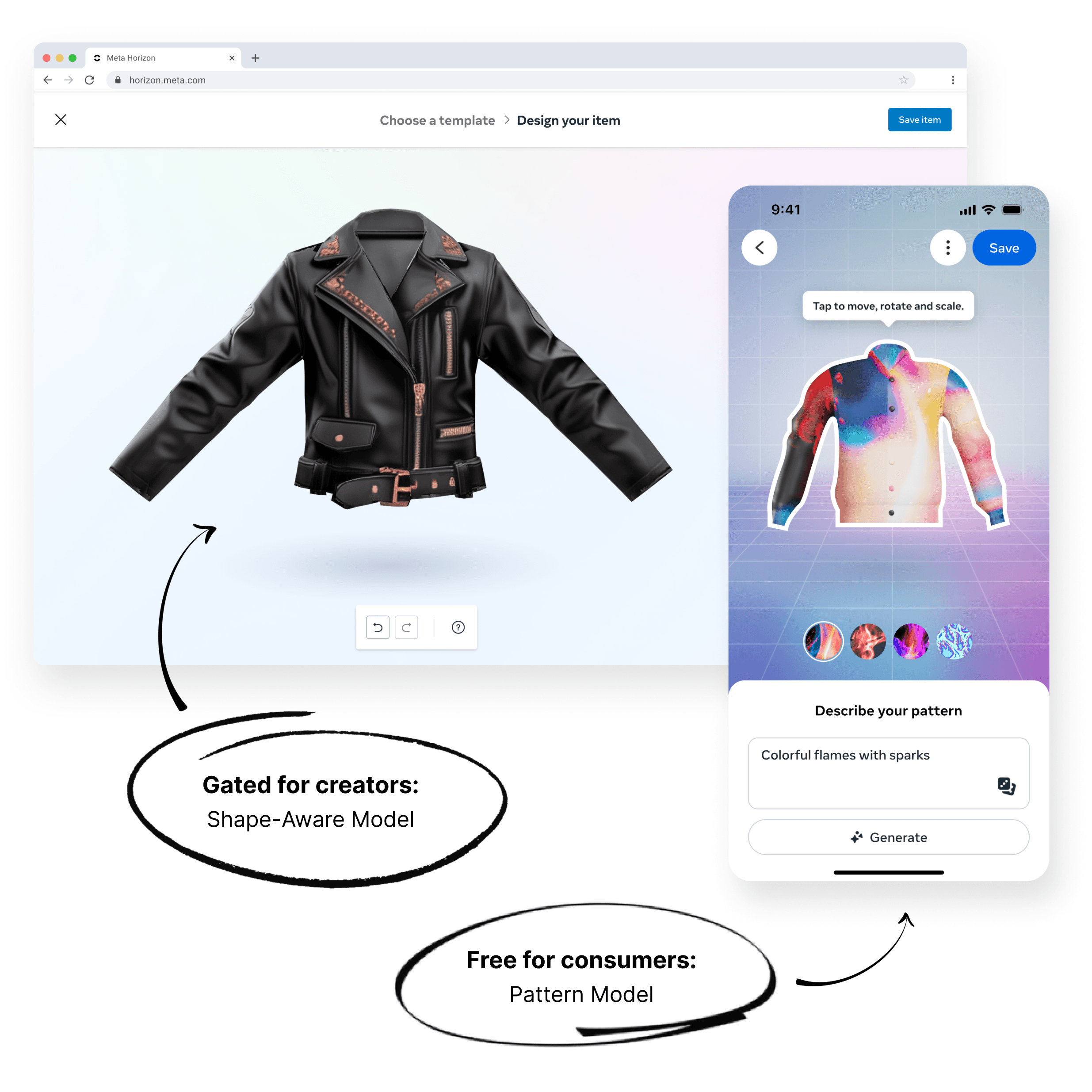
I worked with my AI engineers to train two different models for designing avatar clothing textures. The one I had just launched for the free consumer tool created repeat patterns, while we secretly developed a more powerful “shape-aware” retexturing model meant for monetizing creators only.
Asset bundle download, open tool editing, and reupload
Responding to creator needs: Open tooling for creative control
I built clickable prototypes, wired up to the shape-aware AI model, and led in-person sessions with UXR to see how creators used the tool in real time. The biggest "aha" insight? In addition to our AI creation tools, users expected seamless integrations with their preferred editing programs (like Photoshop and Blender) to achieve their creative visions. This led me to design a hybrid creation flow combining Meta's AI texture generation with professional editing workflows.

A custom Avatar Clothing item for sale in a game
Successful launch and creation of in-game economies
Together with my XFN team, I launched the MVP in Meta's Developer Dashboard web management platform. In the first month it generated $554K in TPV, exceeding our $480K goal, and achieved $0.048/hr monetization efficiency, outperforming Roblox’s competitive benchmark. Creators earned $337K through the platform, and roughly 700 creators produced over 80,000 items during beta.

Design system and feature improvements at a glance
AI-native design system overhaul
With the success of my MVP launch came insights and continued funding to implement requested features and refresh with an AI-native design system update. My org had just begun building a new game management web platform. Instead of "lifting and shifting" the MVP to its new home, I seized the opportunity to propose an AI-native design system overhaul and feature improvements from feedback.
AI-native design system Style Guide
Building in Cursor: A new design process
To show my org what was possible, I built a brand new AI-native design system from the ground up in Cursor, then used it to vibe code a new iteration of my Creator Tool experience showcasing feature improvements addressing user feedback from the MVP. This approach allowed me to got a coded, functioning demo in front of XFN and design leads at lightning speed, while demonstrating the power of AI-first design processes.
Post-MVP improvement: Prompt enhancement
MVP users told us they wanted help understanding how to get the best results from the model, and since our system was already automatically enhancing prompts under the hood, I designed a feature that exposed this functionality to users as an option. I found that users loved the transparency in seeing how their results varied with and without 'enhancing' their prompts, learning how to better work with our model while improving satisfaction with final outputs.
Editing clothing template components
Post-MVP improvement: Component customization
Due to timeline and Tech Art bandwidth constraints, the MVP experience didn't allow users to edit the shape of the clothing meshes. Since shape customization was one of our most requested features, my Tech Artists built an editable components system for the post-MVP release. I designed UX improvements allowing users to customize mesh components and textures, with AI tooling capable of designing the entire garment instead of just ImageGen.

Generate from photo feature
Post-MVP improvement: Generate from photo
MVP creators told us that often times, they already had an idea in mind of what they wanted to create, and in many cases they had images on hand that they'd either found as inspo or created in tools like Photoshop or Blender. So I designed a a feature allowing users to select photos or drag and drop them into the tool, knowing our AI could scan and reference the imagery for better outputs.

